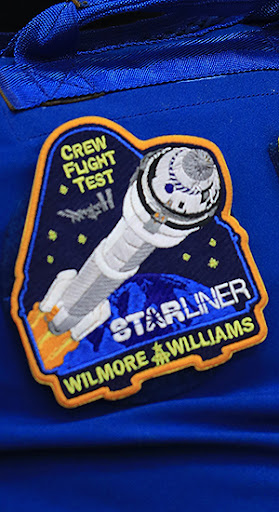
The Starliner space capsule lifted off earlier today for a journey to the International Space Station.
Boeing’s Starliner finally launches with two NASA astronauts : NPR
Astronauts Barry “Butch” Wilmore and Sunita “Suni” Williams are serving as commander and pilot for the capsule. Before launch, they exited NASA’s Johnson Space Center to the cheering of onlookers, and Butch flung a handful of mission patches out to the crowd.
It got me to thinking about various aviators I’ve known who all seem to have an abundant collection of mission and unit patches. Back as a kid in the Boy Scouts, we had a tendency to cherish that special patch from that special camp or event. This tradition goes back to the American Civil War when soldiers of the Army of the Potomac made insignia to identify the units they belonged to. Reportedly they discontinued this practice after the war, only to reinstitute it during World War I and after.

With the proximity to tomorrow’s 80th anniversary of the D-Day landings in Europe, I present to you the SHAEF patch. That is, the “Supreme Headquarters Allied Expeditionary Force” patch that everyone on General Dwight Eisenhower’s HQ Staff wore up until the surrender of Nazi Germany.1 The rainbow’s meaning has evolved in recent decades, but I would venture to guess back then its presence on the SHAEF patch represented the promise of a brighter day and the necessity of the ‘flaming sword’ of war to bring that day to fruition.
I can’t help but ponder over the sacrifices of D-Day, the necessities of keeping peace in a troubled world, and the often-used flames now representing the propulsions of rocket engines. It is curious to see these great aspirations detailed and preserved in simple patches. The phrase in Virgil’s Aeneid comes to mind: “Sic Itur Ad Astra,” meaning “thus one journeys to the stars,” and so we go… with rainbows and swords and unspeakable bravery toward hope for humanity.
- “SHAEF D-Day Patch.” The National WWII Museum Store, 1 Jan. 2024, store.nationalww2museum.org/shaef-d-day-patch/. Accessed 5 Jun. 2024. ↩︎




 Just Joe
Leave a comment